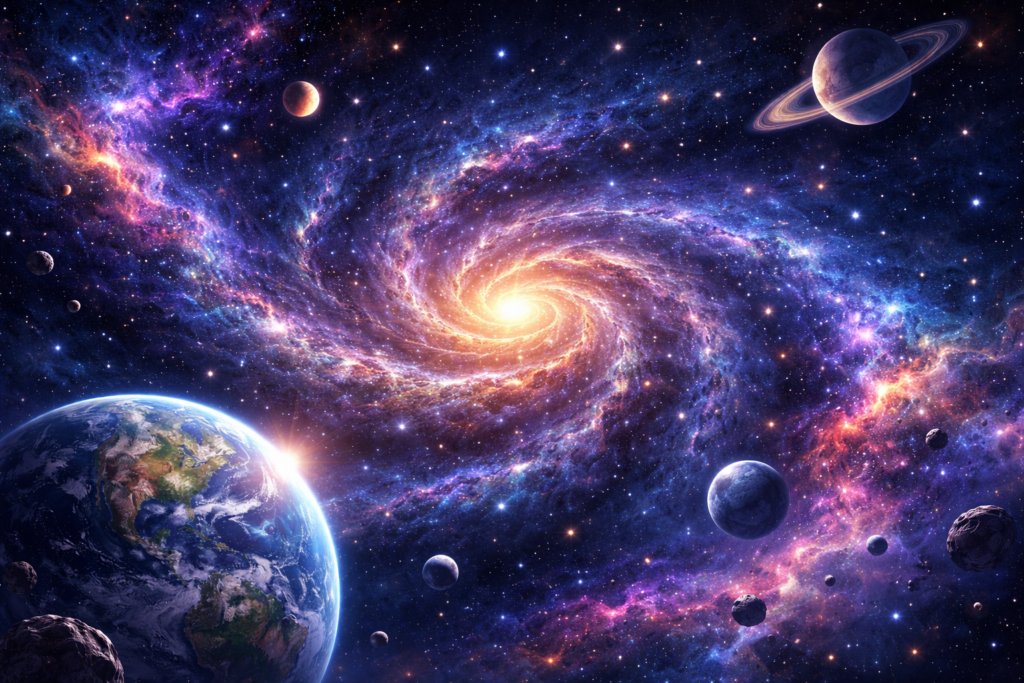
One of my greatest interests is the Universe. I’m fascinated by how vast and mysterious the cosmos is. According to scientific theory, it all began with a massive explosion called the Big Bang. The universe is approximately 13.8 billion years old and is constantly expanding at an accelerated rate. It consists primarily of mysterious dark energy and dark matter, with visible matter (stars and planets) making up only a fraction of the total. It’s estimated that there are over 2,000 billion galaxies, and there are more stars than there are grains of sand on Earth.
The most interesting facts and information about the Universe:
-
Composition of the cosmos: Only about 20% of the universe’s mass is visible matter. The rest is invisible dark matter and dark energy, which is causing the universe to expand at an accelerated rate.
-
Size and stars: There are an estimated 2 trillion (2,000 billion) galaxies in the universe. There are more stars than there are grains of sand on all the beaches on Earth.
-
Largest structure: The largest known structure is believed to be the Hercules-Corona Borealis Great Wall, which is over 10 billion light-years long.
-
black hole has such strong gravity that nothing, not even light, can escape from it.
-
Mars has the largest volcanoes in the entire solar system.
-
There may be billions of Earth-like planets in our galaxy (the Milky Way).
-
Astronauts in space are slightly taller than on Earth because their spines stretch in weightlessness.
-
When you look at the sky, you see the past – the light of some stars has been reaching us for millions of years.
There are many different types of objects in the universe, including stars, planets, moons, asteroids, and comets. Some stars are much larger than the Sun, such as UY Scuti, while others are smaller but extremely dense, like neutron stars.Gravity plays a very important role in space. It keeps planets in orbit and holds galaxies together. In some extreme cases, gravity can become incredibly strong, creating objects known as black holes. These objects can trap everything, even light.The universe is also filled with mysteries. Scientists have discovered that most of it is made of something we cannot directly see, called dark matter and dark energy. These unknown substances make up the majority of the universe, but we still do not fully understand them.
- No Center: The universe does not have a central point; everything is moving away from everything else.
- Low Temperature: The average temperature of the universe is quite cold, hovering around degrees above absolute zero (°C).
- Shape: Recent measurements suggest the universe is „flat” or nearly flat, meaning it could expand forever.
- Age Proportion: Earth is 4.5 billion years old, which is only about one-third the age of the universe.
- Looking into the Past: When you look at the stars, you are looking at history. Light from the closest star (Proxima Centauri) takes 4.2 years to reach us. Some stars you see in the night sky might have already exploded thousands of years ago, but their light is only just reaching Earth now.
- The Cosmic Microwave Background: There is a „glow” left over from the Big Bang that fills the entire universe. If you could see microwave light, the whole sky would glow with a uniform brightness.
- The Diamond Planet: Scientists discovered a planet called 55 Cancri e that is twice the size of Earth and is likely composed of one-third pure diamond due to the extreme pressure and heat.
- Rogue Planets: There are billions of „homeless” planets wandering through the darkness of space that don’t orbit any star. They were likely kicked out of their original solar systems during formation.
- The Great Red Spot: Jupiter’s famous storm has been raging for at least 350 years and is large enough to fit two or three Earths inside it.